TEXT ......
A blog about travels, stories, communities, events, protecting the environment, from the heart of Watsons Bay, Sydney, Australia
Friday, 28 April 2017
Travelling the Hume and Hovel Track, NSW (from Holbrook to Yass)
Friday, 21 April 2017
Eggs Gilhooley
Eggs Gilhooley
All residents of our house believed in a good hearty breakfast to sustain us through a busy
day. In winter it was generally rolled oats cooked in a two-pot blue boiler, with hot water in the bottom pot, to heat the rolled oats in the top without burning them.
At the weekend when things were more relaxed and we weren't rushed to get to work, we often had scrambled eggs on toast. Six eggs were beaten with a small amount of milk and tipped into a pan with hot melted butter so they would sizzle when they hit the butter. Mum's theory was the heat had to be high so the eggs would be browned on the bottom, not come out insipid and custardly, because we had a day’s surfing in front of us, and we needed loads of energy to crack the big one.
Mum was talented – she could read a book, while knitting a sweater, generally a fairisle: two for Billy, one for Harry, one for Ken, two for Tim, one for Josh and one for Guy and another for George while having a glass of wine; it’s called multi-tasking now, but in the 1950's it was normal living.
Mum was a keen reader. She had a book list she wanted to read, when heading for the library, and subscribed to the Observer. One of my jobs was to call at Fiorelli's in Surry Hills to collect a demijohn of red wine, which I helped my stepfather Bill decant into a dozen bottles. This wine was used in some of Mum's cooking – casseroles and spaghetti sauce, but not in the potato pie. It also helped to stimulate conversation at dinner!!
Bill was a keen sailor; as a schoolboy he would sail on Sydney Harbour. He joined the navy when war broke out and spent time in England acquiring valuable information, which he passed on to us. When in London purchase Wild Woodbine cigarettes and light them on the Eternal flame. While in port in Simonstown, South Africa, Bill took up the local language, Negs vor Blanks, Alli stations neer Capstad, while riding the rail to Capetown.
Bill was one of the crew of Query the 12 foot skiff that won the Australian championship on the Brisbane River; the other members were Harry the for’ard hand and Colin the skipper. All these sailors and their mates enjoyed keg parties, which occasionally took place in our kitchen. There was a nine-gallon wooden keg, placed on our sturdy kitchen table ready for the main performance of the night: punching the tap in! This could only be performed by a skilled operator, as a faulty insertion resulted in beer gushing out the side of the tap and being lost on the floor – very sad experience to keen beer drinkers.
There was generally some music and song, with Harry playing the guitar and Bill on the piano accordion, rendering old sea shanties and other bawdy songs – ‘My Old Man's a Dustman’. Bill was also skilled with his bosun’s whistle, on which he would give appropriate calls for naval procedures like ‘coming along side’. Among the guests were some very keen beer drinkers including Skinny who would remark if the drinking slowed down ‘Youse will never drink it’ which was akin to failure of this drinking team.
Guests included Dorothy, John and Roma, Ross and Wendy, Louie and Nan. Louie was quite a character, with very Italian features, dark wavy hair, stocky build, slightly bent nose, and a nasal voice, with a great sense of humour and a volume of funny stories. He also operated as SP booker, besides having a day job. After the war there was a demand for betting, before Tab Corp set up. This was generally done by SP bookmakers operating out of local pubs, or in back lanes away from police view, as it was illegal.
Louie's work commenced with donning his grey dust coat, getting into the van and doing deliveries for the local flying-boat base. But he had an Sp betting agency on the side.So come Monday he would have to visit his clients and "Settle Up "after Saturdays racing.He generally carried a roll of notes you could'nt jump over.
Some of this money went to house renovations and paying me to help paint his house.
. For recreation what did this group do in winter on a Sunday ? They went sailing, not in a12 skiff but a large 30 foot yacht, loaded up with a staple diet of beer, meat for a barbecue and salads, plus a little wine for appreciation. Depending on weather conditions, all sailors know you must check the forecast, observe the sky and the breeze, consider the tide and then consult with the skipper Ross as to their chosen destination. There was a fine choice of intimate beaches for swimming, picnicking and all round fun; these included, Stores Beach, Forty Baskets, Reef Beach, Castle Rock, Chowder Bay, and their favourite: Cobblers Beach, because it faced north and was protected from southerly winds. By Grainfed grandfather Tim
an extension of freedom
Mum was talented – she could read a book, while knitting a sweater, generally a fairisle: two for Billy, one for Harry, one for Ken, two for Tim, one for Josh and one for Guy and another for George while having a glass of wine; it’s called multi-tasking now, but in the 1950's it was normal living.
Mum was a keen reader. She had a book list she wanted to read, when heading for the library, and subscribed to the Observer. One of my jobs was to call at Fiorelli's in Surry Hills to collect a demijohn of red wine, which I helped my stepfather Bill decant into a dozen bottles. This wine was used in some of Mum's cooking – casseroles and spaghetti sauce, but not in the potato pie. It also helped to stimulate conversation at dinner!!
Bill was a keen sailor; as a schoolboy he would sail on Sydney Harbour. He joined the navy when war broke out and spent time in England acquiring valuable information, which he passed on to us. When in London purchase Wild Woodbine cigarettes and light them on the Eternal flame. While in port in Simonstown, South Africa, Bill took up the local language, Negs vor Blanks, Alli stations neer Capstad, while riding the rail to Capetown.
Bill was one of the crew of Query the 12 foot skiff that won the Australian championship on the Brisbane River; the other members were Harry the for’ard hand and Colin the skipper. All these sailors and their mates enjoyed keg parties, which occasionally took place in our kitchen. There was a nine-gallon wooden keg, placed on our sturdy kitchen table ready for the main performance of the night: punching the tap in! This could only be performed by a skilled operator, as a faulty insertion resulted in beer gushing out the side of the tap and being lost on the floor – very sad experience to keen beer drinkers.
There was generally some music and song, with Harry playing the guitar and Bill on the piano accordion, rendering old sea shanties and other bawdy songs – ‘My Old Man's a Dustman’. Bill was also skilled with his bosun’s whistle, on which he would give appropriate calls for naval procedures like ‘coming along side’. Among the guests were some very keen beer drinkers including Skinny who would remark if the drinking slowed down ‘Youse will never drink it’ which was akin to failure of this drinking team.
Guests included Dorothy, John and Roma, Ross and Wendy, Louie and Nan. Louie was quite a character, with very Italian features, dark wavy hair, stocky build, slightly bent nose, and a nasal voice, with a great sense of humour and a volume of funny stories. He also operated as SP booker, besides having a day job. After the war there was a demand for betting, before Tab Corp set up. This was generally done by SP bookmakers operating out of local pubs, or in back lanes away from police view, as it was illegal.
Louie's work commenced with donning his grey dust coat, getting into the van and doing deliveries for the local flying-boat base. But he had an Sp betting agency on the side.So come Monday he would have to visit his clients and "Settle Up "after Saturdays racing.He generally carried a roll of notes you could'nt jump over.
Some of this money went to house renovations and paying me to help paint his house.
. For recreation what did this group do in winter on a Sunday ? They went sailing, not in a12 skiff but a large 30 foot yacht, loaded up with a staple diet of beer, meat for a barbecue and salads, plus a little wine for appreciation. Depending on weather conditions, all sailors know you must check the forecast, observe the sky and the breeze, consider the tide and then consult with the skipper Ross as to their chosen destination. There was a fine choice of intimate beaches for swimming, picnicking and all round fun; these included, Stores Beach, Forty Baskets, Reef Beach, Castle Rock, Chowder Bay, and their favourite: Cobblers Beach, because it faced north and was protected from southerly winds. By Grainfed grandfather Tim
an extension of freedom
Thursday, 20 April 2017
Thursday, 13 April 2017
Monday, 27 March 2017
Afrikaan
13 Mar at 5:32 PM
> Goeie middag Tim,
> Hoe gaan dit met u? Ek was in Springs Transvaal gebore. My Oupa en sy broer het daar geboer. My Oupa en sy broer het teen die Britse geveg. As a gevolg daarvan het hulde baie geld verloor, maar dis in die verlede.
> My vrou en ek het drie kinders, nege Kleinkinders en vyf Agterkleinkinders. Ek is bly om te se die hele gesin lewens in Australia.
> Sien u Maandag by ons Duitse lesing.
> Totsiens,
> Brian.
Friday, 24 March 2017
Family Motor Cycling History
I am gazing at a very old photograph of a very old motorbike. Its
taken round 1922 on the Walch to Armidale road.Its a Douglas opposed
twin motor with a rectangular fuel tank,
sweptback handlebars, and exposed flywheel,
a fairly primitive machine but it transported my father Fred Williams
round the northern NSW dirt roads in his job as a representative for Williams
Bros Motors.
Now weather its genetic or not,I dont know but I took an instant
liking to riding on the back of Geoffrey's 500 CC Tiger 100 twin motor
bike when he drove through French's Forest and down Tumble Down Dick,the
acceleration of these machines was very rapid from 30mph to 100 mph in
30 seconds, The feeling of wind in the hair with associated
thoughts of freedom were very apparent .
This is 1948 , prior to regulations requiring motor Cycle riders to wear
helmets
These machines were the fastest 500 cc stock motor cycle available.
There was a faster stock bike, but it was 1000 cc V twin Vincent HRD ,capable
of speeds exceeding 120 mph. The
NSW Police selected Triumph Tiger 100 motor cycles for
their Highway Patrols.
At age 16 years and 10 months it was possible to sit for a
riders licence, this test was conducted in Hospital Road, abreast of the
Domaine by RTA officers. The test
involved driving 50 meters down the road, making a U turn
without putting a foot on the ground, observed by the RTA officer standing in
the middle of the road.
Most motorcycle riders would understand this required the rider to
operate the hand clutch, change gear by foot controller ,one up and three down,
apply the foot brake, and give a
right hand signal for turning. This is prior to electric indicators
blinking direction changes, so one hand had to come off the handlebars,
where the accelerator is located.Need I say more, for a
nervous person the opportunity to dab a foot on the ground while
turning the handlebars, to prevent a fall, was just too
great. Needless to say I failed my test.
Eventually I secured my motorcycle licence at 17.Now all I needed
was a motor bike, and who better to help me than father Fred.He negotiated
a sale with Campbell street agents Hazell & Moore, having worked in
the area pre war,lent me 100 pounds and I rode home on a shiny new Tiger
100 motor bike.
FAMILY MOTORCYCLE HISTORY
Family Motor Cycles History
I am gazing at a very old photograph
of a very old motorbike.Its taken round 1922 on the Walch to
Armidale road.
Its a Douglas opposed twin motor with a rectangular fuel tank,sweptback handlebars, and exposed flywheel,a fairly primative machine but it transported my father Fred Williams round the northern NSW dirt roads in his job as a representative for Williams Bros Motors. Now wheather its genetic or not,I dont know but I took an instant liking to riding on the back of Geoffrey's 500 CC Tiger 100 twin motor bike when he drove through French's Forest and down Tumble Down Dick,the accelleration of these machines was very rapid from 30mph to 100 mph in 30 seconds, The feeling of wind in the hair with associated thoughts of freedom were very apparent .
Tuesday, 7 March 2017
Friday, 3 March 2017
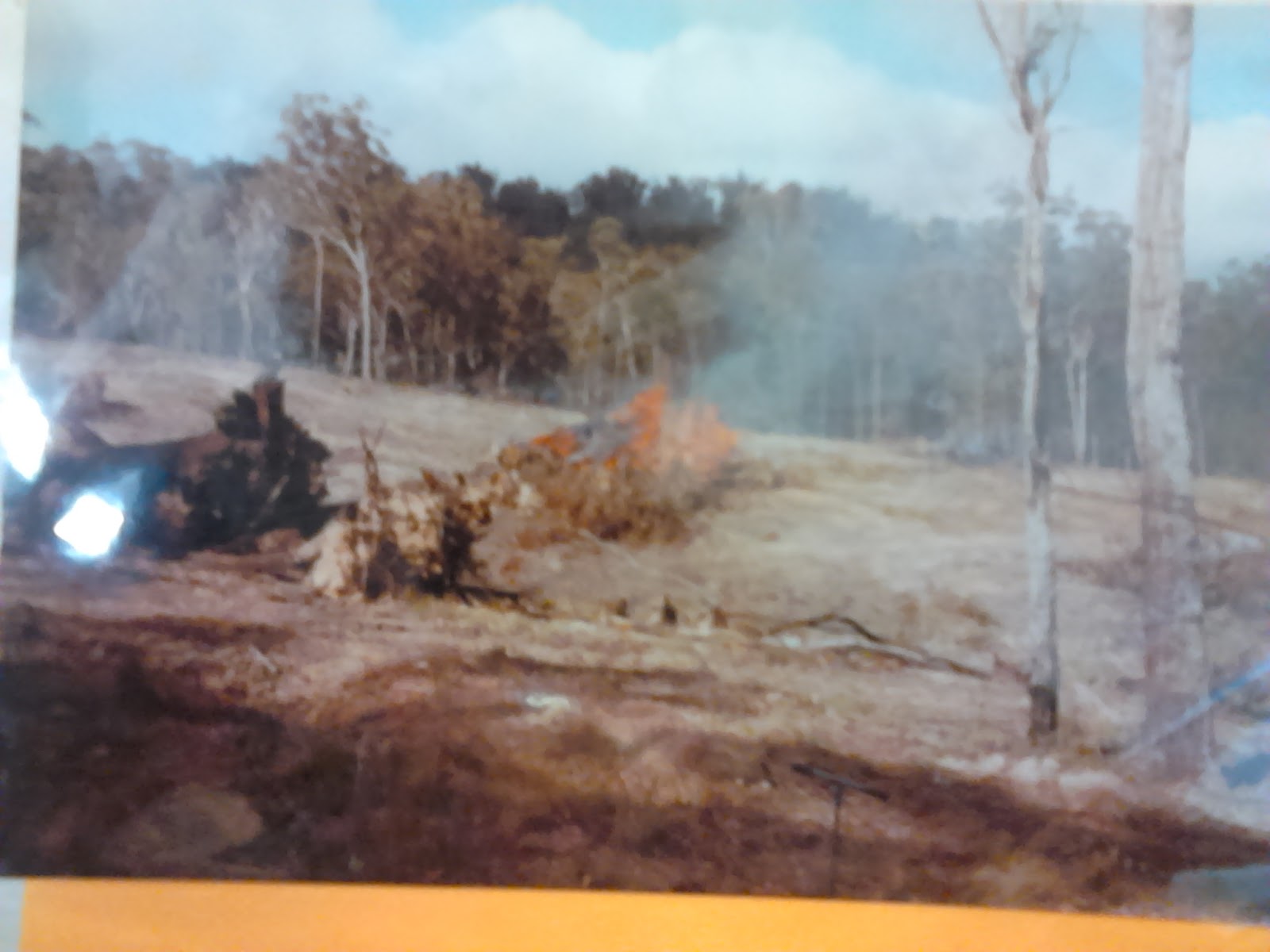
SALIGNA WOODLOT - The clearing and planting of a new planation, Kangaroo Flat (NSW, Australia)
She approached me along the forest trail dressed in her khaki drill uniform from Greening Australia .I had rung asking for advice in the preparation of planting 5 acres of Sydney blue gum .Her name was Annabel Kater and with her camera we surveyed the land that had been prepared for planting.
Bob Carr the then Premier who for political reasons had changed the State Forests regulations ,so former State Forests could be converted to National Parks ,a neat political trick to enhance his standing . Once done it achieved his kudos.
Carr’s next step was to call on the landholders of the region to start planting trees to create a resource for the local sawmill at Walcha.
I’m not sure if Annabel knew about all these political moves but she was certainly knowledgeable about species selection,Silva culture, weed control and the necessary methodology to accomplish all these practices. With camera she documented the slope in the land already conscious of the high rainfall on the tableland region and that Sydney Blue gum do well in this area.
A younger man may have involved her in a relationship because she was attractive very easy to talk to and certainly friendly,but being old I accepted that it was better to stick to business practices and obtain the information that would create a successful wood lot Sydney Blue gum is of particular good flooring quality,in its mature state it can grow to 30-55meters in height,with a diameter at brest height of 2 meters . Exceptional species may attain a height of 65 meters with a girth of 2.5 meters,resulting in an excellent sawlog that the most emasculated sawmiller would salivate over.
It is common in an area from the South Coast of New South Wales to as far north as the Eungella area west of Mckay in Queensland,growing to as far west as Carnarvon Gorge.it can survive in altitudes up to 1100 meters.This climate area is mostly warm humid with mean temperatures of the hottest month in the range of 24-33 degrees and mean minimum of the coldest round -2 to 8 degrees. The mean annual rainfall is around 900 – 1800 mm,with a summer maximum ,moderate in the south but strong in Queensland.
Best development of this species is on good quality alluvial sandy loam,other soils pod sols and volcanic loam.Soils are generally moist but well drained.
The species is characterized by its rough brownish to grayish flakey bark,retained at the base for 1-4meters ,decorating in long strips to leave smooth,blueish grey to white surface above .The Eucalyptus species is the most important genus of Australia forest trees with about 500 species,many are site sensitive and have edaphic preferences.
The only shelter on Lot 29 Bloomfield road is a rough hut 6 meters by 3 meters fashioned from species grown on the block,milled at Long Flat to provide steeps to the loft,where the occasional possum rests from storms.The roof is rusty recycled corrugated iron,and flooring that can claim a 100 years of use.100 mm slabs decorate the exterior walls.
Annabel and I shared afternoon tea and cake after our trevail,on the meager slatted deck ,discussing other species such as the wondrous cabinet timber Acacia melanoxlyn,or blackwood as it is known in the trade.All this talk must have made an impression because there is now a experimental grove of Acacia melanoxlyn grown from seed collected from a tree growing at St Ives,growing on the blook,but theirs is a 40 year cycle so wont be harvested by yours truly.
Annabel was not exposed to the wondrous sounds that are audible at Saligna at night,unidentified birds hoot,dingoes howl,possums fornicate in rapturous delight,the odd bull sends out a call for company,the place come alive all that is missing is David Attenborough’s commentary.
The final chapter to the saga is the sawmill closed down,so there is 5000 square meters of structural building timber,possibly enough for two sustainable houses,left talking to nature,I hope they have the language right.
©copyright T. Williams
Subscribe to:
Posts (Atom)